Crochet Flowers: A Maker’s Guide to Building Your First Bouquet
Crochet flowers solve a problem that garment and blanket patterns…
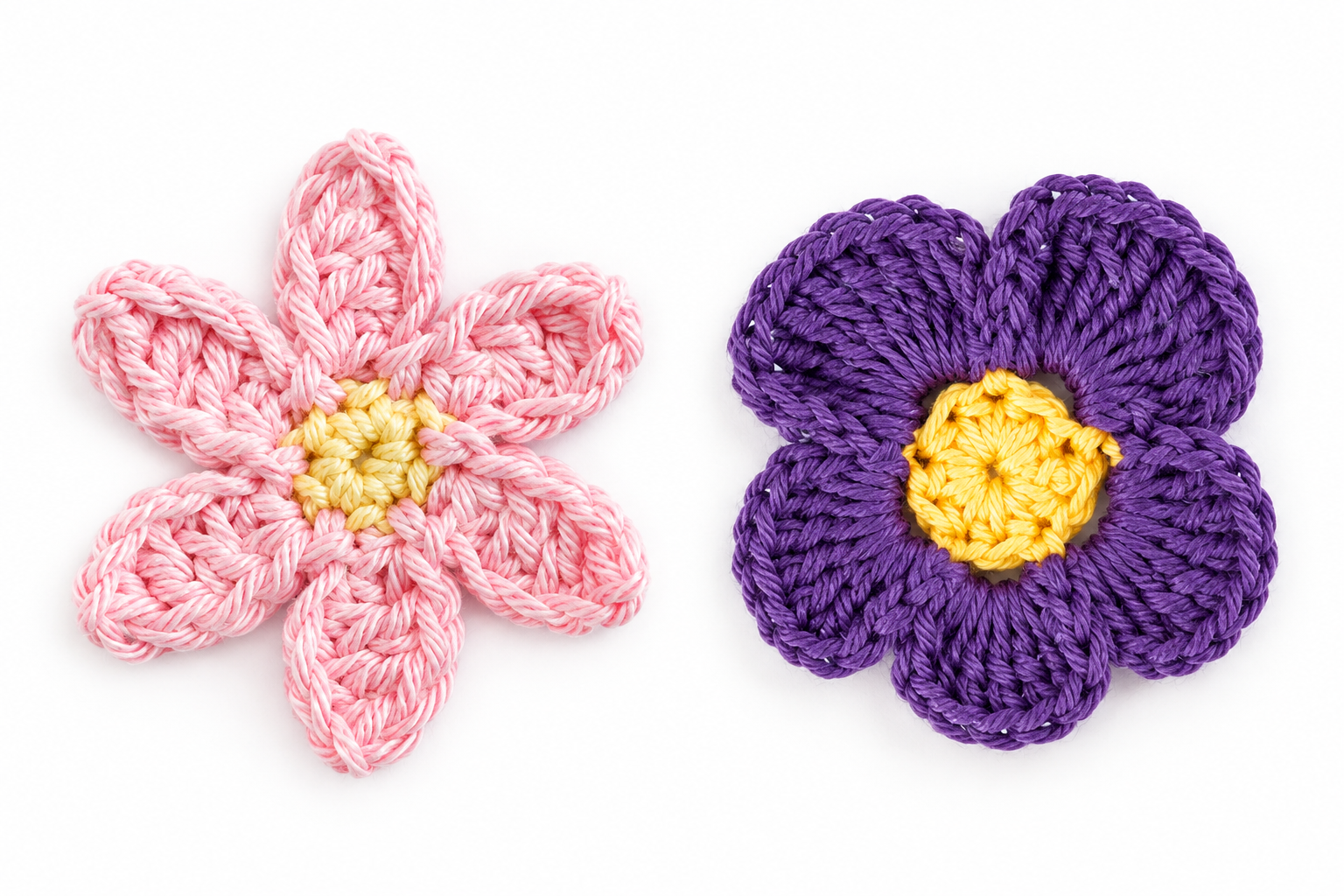
Crochet flowers solve a problem that garment and blanket patterns don’t — they’re small enough to finish in one sitting, forgiving enough for a genuine beginner, and useful in more ways than almost any other amigurumi-adjacent project. A single flower motif can become a brooch, a hair clip, an appliqué on a blanket, or one piece in a full bouquet, which is exactly why they’re such a popular entry point into crochet flowers bouquet projects generally.
As someone who spends a lot of time around how to crochet flowers and how to make crochet flowers specifically, the questions that come up most are about where to start, what materials you actually need, and which flowers are genuinely easy versus which just look simple in photos. This guide covers all of it, then features five complete crochet flowers free patterns ranging from true-beginner to a bit more involved.
Key Takeaways
- Simple round or six-petal flowers, like the daisy below, are genuinely the easiest starting point — most can be finished in well under an hour once you know the basic ring-and-petal structure.
- You don’t need specialty materials to start — worsted weight yarn, a standard hook, and a yarn needle for weaving in ends cover almost every basic flower pattern.
- Crochet flowers aren’t inherently difficult; what varies is petal count and rounds of shaping, not a fundamentally different skill level.
- A bouquet doesn’t require identical flowers — mixing a few different, simple patterns (like the five below) creates a more visually interesting arrangement than repeating one design.
- Five complete patterns — daisy, sunflower, pansy, trumpet flower, and a traditional rose — are included in full below.
Which Flower Is the Easiest to Crochet?
A basic six-petal daisy, built from a small ring of single crochet with simple petal chains worked around it, is about as approachable as crochet flowers get — the entire thing is just two rounds, with no shaping decisions or stitch counting beyond following a repeated sequence. That kind of quick, single-sitting project is exactly what people are usually looking for when they ask what they can crochet in an hour or want a genuine first project that doesn’t require prior amigurumi experience.
From there, difficulty increases gradually with petal count and the number of rounds — a sunflower or pansy involves a few more rounds of shaping than a daisy, but nothing that requires a fundamentally different skill, just more repetition and patience.
How Do You Crochet a Flower for Beginners, and Can You Build a Bouquet Easily?
Every flower pattern in this guide follows the same basic logic: start with a small foundation ring, work one or more rounds to build the center, then add petals as a final round or separate step. Once that structure clicks for one flower, it transfers directly to the others — a daisy and a pansy are more similar under the hood than their finished appearance suggests.
Building a full bouquet doesn’t require making a dozen of the same flower. Mixing 2 or 3 different patterns — say, a handful of daisies, a few sunflowers, and one or two roses — creates a more natural, varied arrangement than a uniform batch, and it’s also a more efficient way to practice several different techniques rather than repeating just one.
What Materials Do You Actually Need for Crochet Flowers?
The material list for basic crochet flowers is short: worsted weight yarn in your chosen colors, a crochet hook sized to that yarn (typically a US size D–H range works well for lighter flower motifs), scissors, and a yarn needle for weaving in ends. If you’re planning to turn finished flowers into brooches or stems for a bouquet, floral wire, floral tape, and a hot glue gun or brooch backing are common additions, but none of that is required just to make the flower itself. Crochet flowers genuinely aren’t difficult to start — the barrier to entry is lower than most other amigurumi projects specifically because the finished pieces are small and quick.
What Are Some of the Best and Prettiest Crochet Flowers?
“Prettiest” is subjective, but certain flowers consistently show up as favorites because of how much visual payoff they deliver relative to their difficulty. A traditional rose, with its layered rounds of petals, tends to read as more elaborate than its actual construction — it looks like it should be harder than it is, which makes it a satisfying step up once you’ve got a daisy or two under your belt. For a bouquet specifically, combining a rose or trumpet flower as a visual centerpiece with simpler daisies and a sunflower filling in around it tends to produce the most balanced, gallery-worthy result.
Featured Patterns: 5 Crochet Flowers to Make
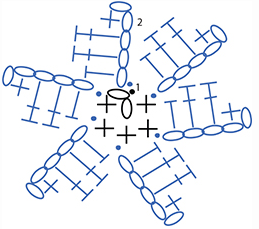
1. Six-Petal Daisy
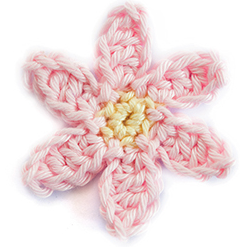
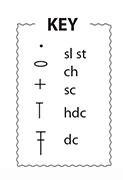
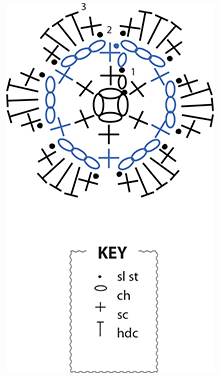
Make 2 ch.
Rnd 1: 5 sc into 2nd ch from hook, sl st into 2nd of 2 ch to form a ring. (6 sc)
Rnd 2: (5 ch, 1 sc into 2nd ch from hook, 1 dc into each of next 2 ch, 1 hdc into last ch, sl st into next sc of rnd 1) 6 times.
Fasten off.
2. Small Sunflower
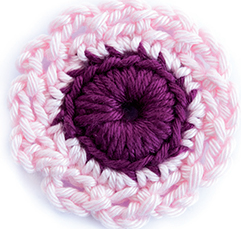
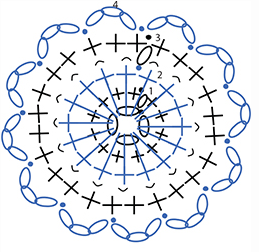
Make 4 ch and join with sl st to form a ring.
Rnd 1: 1 ch, 12 sc into ring, sl st into first sc.
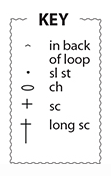
Rnd 2: 16 long sc into ring over the sc of rnd 1, sl st into first sc.
Rnd 3: Working into the back loop only, 1 ch, 2 sc into same sc, 1 sc into next sc, (2 sc into next sc, 1 sc into next sc) 7 times, sl st into first sc. (24 sc)
Rnd 4: (3 ch, miss 1 sc, sl st into next sc) 12 times.
Fasten off.
3. Pansy
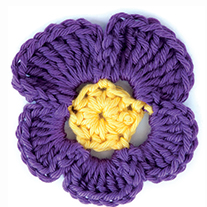
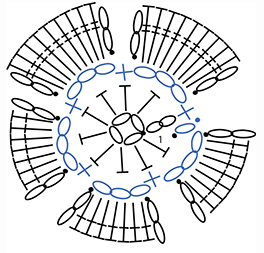
Make 4 ch and join with sl st to form a ring.
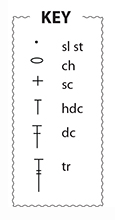
Rnd 1: 2 ch (counts as 1 hdc), 9 hdc into ring, sl st into first hdc.
Rnd 2: 1 ch, 1 sc into same place, (3 ch, miss 1 hdc, 1 sc into next hdc) 4 times, 3 ch, miss 1 hdc, sl st to first sc.
Rnd 3: (Sl st, 2 ch, 9 tr, 2 ch, sl st) all into each of the first and second 3-ch spaces; (sl st, 2 ch, 7 dc, 2 ch, sl st) all into each of the next three 3-ch spaces.
Fasten off.
4. Trumpet Flower
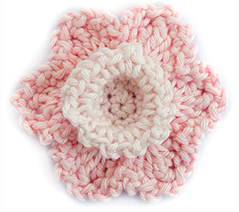
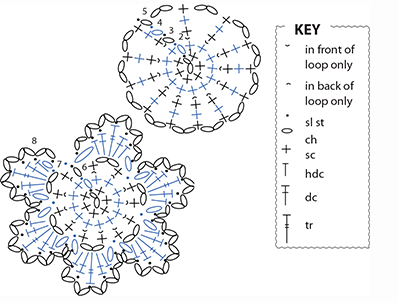
Centre
Make 2 ch.
Rnd 1: 6 sc into 2nd ch from hook, sl st to first sc.
Rnd 2: 1 ch, 2 sc into each sc, sl st into first sc. (12 sc)
Rnd 3: 1 ch, 1 sc into front loop of each sc, sl st into first sc.
Rnd 4: 1 ch, 1 sc into each sc, sl st into first sc.
Rnd 5: 1 ch, 1 sc into first sc, 2 ch, (1 sc into next sc, 2 ch) 11 times, sl st to first sc.
Fasten off.
Petals
Rejoin yarn to the back loop of any dc on row 3.
Rnd 6: 1 ch, 1 sc into same place, (2 ch, 1 sc into back loop of each of next 2 sc) 5 times, 2 ch, 1 sc into back loop of last sc, sl st to first sc.
Rnd 7: Sl st into first 2-ch space, *(1 ch, 1 hdc, 1 dc, 1 tr, 1 dc, 1 hdc, 1 ch) all into 2-ch space, sl st between next 2 sc; rep from * 5 times more.
Rnd 8: *Sl st into 1-ch space of petal, (2 ch, sl st into next st) 5 times, 2 ch, sl st into last 1-ch space of petal; rep from * 5 times more.
Fasten off.
5. Traditional Crochet Rose
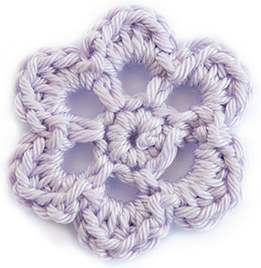
Make 4 ch and join with sl st to form a ring.
Rnd 1: 1 ch, 6 sc into ring, sl st to first sc.
Rnd 2: 1 ch, 1 sc into same sc, (3 ch, 1 sc into next sc) 5 times, 3 ch, sl st into first sc.
Rnd 3: Sl st into first 3-ch space, (1 sc, 3 hdc, 1 sc, sl st) all into same 3-ch space; (sl st, 1 sc, 3 hdc, 1 sc, sl st) all into each of the next five 3-ch spaces.
Fasten off.
Frequently Asked Questions
Which flower is the easiest to crochet?
A basic six-petal daisy — just two rounds with no shaping decisions, making it one of the fastest and most approachable flowers to make.
What are 10 free crochet flower patterns for beginners?
Look for patterns with two to three rounds and minimal shaping, like a daisy, a simple sunflower, or a basic rose — the five patterns above cover a good beginner-to-intermediate range.
What is the easiest thing to crochet for beginners?
Small, flat motifs like flowers are among the easiest starting projects, since they finish quickly and don’t require garment shaping or fitting.
How do you crochet a bouquet of flowers easily?
Mix a few different simple patterns rather than repeating one flower — it creates a more natural-looking arrangement and lets you practice multiple techniques.
What materials are needed to crochet a bouquet?
Worsted weight yarn, a matching hook, scissors, and a yarn needle cover the flowers themselves; floral wire and tape are useful additions if you want stems.
Are crochet flowers difficult to make?
No — most are built from a small ring plus one or two rounds of petals, which is more repetition than difficulty.
What is the best crochet flower bouquet?
A mix of a standout flower like a rose or trumpet flower as a centerpiece, filled in with simpler daisies or a sunflower, tends to look the most balanced.
Final Thoughts
Crochet flowers reward a little variety — once you’ve mastered the basic ring-and-petal structure with a daisy, the sunflower, pansy, trumpet flower, and rose above all build on that same foundation with just a bit more shaping each time. Together, they make a genuinely lovely, mixed bouquet without repeating a single pattern.
Give one a try this week, and if your petal count comes out uneven or your rounds don’t lie flat, leave a comment — I’m happy to help you figure out where it went off track.