Envelope Bag Crochet: A Maker’s Guide to Purses, Clutches, and Crossbody Styles
Looking for a new project? This envelope bag crochet pattern…
Looking for a new project? This envelope bag crochet pattern is one of the most versatile shapes in crochet design — clean, structured lines that work equally well as a clutch, a crossbody, or a full-size purse depending on how you scale and finish it.
The envelope silhouette is one of the most versatile shapes in crochet bag design — clean, structured lines that work equally well as a clutch, a crossbody, or a full-size purse depending on how you scale and finish it. It’s also one of the more approachable projects for anyone building confidence with crochet bag pattern construction, since the flap-and-body structure is simpler to plan than a fully seamed tote.
As someone who spends a lot of time around crochet bag pattern design, the questions that come up most are practical ones — how to actually build an envelope purse from scratch, whether granny squares work for this shape, whether clutches are even still fashionable, and which stitch holds up best for a bag or its strap. This guide covers all of it, then walks through a full envelope bag pattern free to follow from start to finish.
Key Takeaways
-
- An envelope purse is typically built from two main body panels plus a joining strip, rather than one continuous piece — that structure is what gives it clean, defined edges.
-
- Granny squares can absolutely be used for an envelope-style purse; the number of squares needed depends on the finished size, with smaller clutch sizes needing far fewer than a full tote.
-
- Clutch bags remain a strong trend for 2026, particularly in structured or textured styles rather than plain smooth panels.
-
- Denser stitches hold up best for both the body and strap of a crochet bag pattern, since bags need to resist stretching under weight.
-
- A full envelope crossbody bag pattern is included below.
How Do You Crochet an Envelope Purse?
The basic structure behind most envelope purse designs comes down to two flat panels — a front body and a back body that extends up into the flap — joined together along the sides and bottom, with a strap or chain added at the end. Working the panels flat, row by row, rather than in continuous rounds, makes it much easier to control the exact shape and get crisp, defined edges once the flap folds down over the front.
Granny squares are a genuinely popular way to build this shape too. Rather than working flat rows, you piece together a set of squares into two panels the size you need, then join them the same way you would flat-worked panels. The number of squares required depends entirely on your target size and gauge — a small clutch might need as few as 8 to 12 squares total, while a larger tote-style bag can call for 20 or more. If you’ve got a stash of 20 granny squares on hand and are wondering what to do with them, a mid-size envelope purse or a compact tote are both realistic, achievable projects for that quantity.
Are Envelope Clutches Still in Style?
Yes, and they’ve held up better than a lot of other handbag trends. Rather than fading out, clutch bags have shifted toward more structured, textured styles for 2026 — think raised stitch patterns, chunky yarn, or cluster stitches that add visual depth, rather than a plain flat panel. That textured, handmade-looking finish is a big part of what’s keeping the crochet clutch relevant, since it offers something a mass-produced leather clutch can’t easily replicate. Clutches overall aren’t out of fashion; if anything, the current trend favours pieces with more visible craftsmanship, which plays directly to crochet’s strengths.
How Do You Make a Simple Crochet Bag for Beginners?
The most beginner-friendly approach sticks to a single, consistent stitch worked in flat rows — double crochet is a common starting point, since it builds fabric relatively quickly and is easy to keep an even tension with. Avoiding pattern repeats that involve multiple stitch heights or cluster stitches until you’re comfortable with the basics keeps the project manageable. A simple rectangular panel, folded and seamed along two sides with a strap added, is realistically achievable in a single sitting or two, which is why “what can I crochet in 2 hours” so often points back to a small bag or pouch as the answer.
What’s the Best Crochet Stitch for Making a Bag?
For the body of a bag, denser stitches — double crochet, half double crochet, or textured cluster stitches — hold their shape better than open, lacy patterns, since bags need to resist stretching under the weight of their contents. For straps specifically, single crochet or a tightly worked chain reinforced with additional rounds tends to be the least stretchy option; if stretch resistance matters most to you, single crochet worked at a tight gauge is generally the safer choice over taller stitches like treble crochet, which have more give built into their structure.
Featured Pattern: Envelope Crossbody Bag
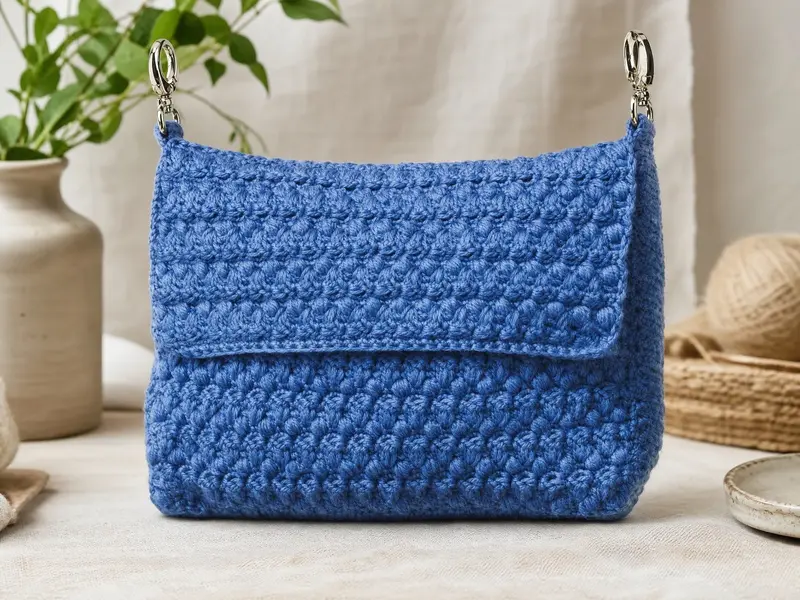
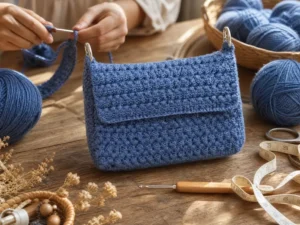
To bring these principles together, here’s a full envelope-style crossbody bag pattern, worked in three sections — a front body, a back body that extends into the front flap, and a joining strip that gives the bag its depth and connects to the strap hardware.
Materials
-
- 4 balls DROPS Merino Extra Fine (100% wool, 50g/105m) in Light Grey Blue (19)
-
- 3mm (US C/2 or D/3) hook
-
- A pair of 2 silver dog clips, 40mm (1½in)
-
- Silver chain, 110cm (43½in) long
-
- Magnetic clasp
Tension
18.5 sts and 23 rows to measure 10x10cm (4x4in) over the 4-row pattern repeat, using a 3mm hook, or size required to achieve tension.
Measurements
21 x 14cm (8¼ x 5½in)
Abbreviations
2-tr cluster (2-tr cl): (Yrh, insert hook in space/st indicated, yrh and pull up loop, yrh and draw through 2 loops) twice, inserting the hook in the same space/st each time, yrh and draw through all loops on hook.
4-tr cluster (4-tr cl): As above, working the bracketed steps 4 times.
Notes
Beginning ch1 does not count as a st throughout. The bag is made of 3 sections: the Front Body, the Back Body/Front Flap, and the Joining Strip.
Front Body
Ch 40.
Row 1 (RS) Dc in second ch from hook and in each ch to end, turn. [39 dc]
Row 2 Ch1, dc in each st to end, turn.
Row 3 Ch1, dc in first st, *4-tr cl in next st 2 rows below, dc in next st; rep from * to end, turn.
Row 4 Ch1, dc in each of next 2 sts, *2-tr cl in next st 2 rows below, dc in next st; rep from * to last st, dc in last st, turn.
Row 5 Ch1, dc in each st to end, turn.
Row 6 As Row 5. Rows 3–6 create the pattern.
Rows 7–34 Rep Rows 3–6 another 7 times. Fasten off.
Back Body and Front Flap
Ch 40. Work Rows 1–6 as given for Front Body.
Rows 7–62 Rep Rows 3–6 another 14 times. Fasten off.
Joining Strip
Ch 13.
Row 1 (RS) Dc in second ch from hook and in each ch to end, turn. [12 dc]
Row 2 Ch1, ss in fl of each st to end, turn.
Row 3 Ch1, dc in fl of each st to end, turn. Rows 2 and 3 create the pattern.
Rows 4–141 Rep Rows 2–3 another 69 times. Fasten off.
To Finish
Sew the dog clips to each end of the Joining Strip by slotting the end of the strip through the clip and sewing together on the inside to secure.
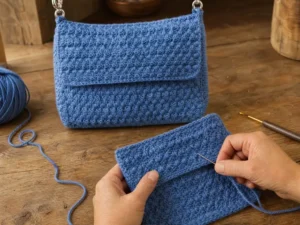
With RS together and WS facing out, pin the Joining Strip to the Front Body panel, leaving the dog clips above. Sew in place.
With RS together and WS facing out, pin the other side of the Joining Strip to the Back Body, leaving the dog clips above. Sew in place.
Turn right side out, attach the chain strap, and add the magnetic clasp to the centre front.
Frequently Asked Questions
How do you crochet a purse step by step for beginners?
Start with a single consistent stitch worked flat, keep the shape to a simple rectangle, and seam two sides before adding a strap — avoid pattern repeats with multiple stitch heights until you’re comfortable with the basics.
What is the best crochet stitch for a purse?
Double crochet or half double crochet for the body gives a dense, sturdy fabric; single crochet worked tightly is the better choice for straps that need to resist stretching.
How do you crochet a purse with granny squares?
Piece together enough squares to form two panels at your target size, then join the panels along the sides and bottom the same way you would flat-worked pieces.
How many granny squares do you need for a purse?
It depends on size — a small clutch might need 8 to 12 squares total, while a larger tote can call for 20 or more.
What can I make with 20 granny squares?
A mid-size envelope purse or a compact tote are both realistic projects for that quantity.
Are clutch bags in style in 2026?
Yes — the trend has shifted toward more structured and textured styles rather than fading out, which favours crochet’s visible stitch detail.
Are clutch bags out of fashion?
No — they remain popular, particularly in versions with raised or textured stitch patterns rather than plain flat panels.
What can I crochet in 2 hours?
A small, simple bag or pouch worked in a single consistent stitch is a realistic project for that timeframe.
What crochet stitch should I use for a bag strap?
Single crochet worked at a tight gauge resists stretching better than taller stitches like treble crochet.
Which crochet stitch is the least stretchy?
Single crochet, particularly at a tight gauge, generally has the least give compared to taller stitches.
Final Thoughts
The envelope silhouette rewards planning more than complexity — two well-shaped panels, a joining strip for depth, and the right stitch for the job matter more than an elaborate pattern. Whether you’re working from granny squares or flat rows like the crossbody pattern above, the same structural principles carry through.
Give this crochet bag pattern a try, and if your panels come out a different size than expected or your gauge doesn’t match, leave a comment — I’m happy to help you adjust it.
Envelope Bag Crochet: A Maker’s Guide to Purses, Clutches, and Crossbody Styles
The envelope silhouette is one of the most versatile shapes in crochet bag design — clean, structured lines that work equally well as a clutch, a crossbody, or a full-size purse depending on how you scale and finish it. It’s also one of the more approachable projects for anyone building confidence with crochet bag pattern construction, since the flap-and-body structure is simpler to plan than a fully seamed tote.
As someone who spends a lot of time around crochet bag pattern design, the questions that come up most are practical ones — how to actually build an envelope purse from scratch, whether granny squares work for this shape, whether clutches are even still fashionable, and which stitch holds up best for a bag or its strap. This guide covers all of it, then walks through a full envelope bag pattern free to follow from start to finish.
Key Takeaways
-
- An envelope purse is typically built from two main body panels plus a joining strip, rather than one continuous piece — that structure is what gives it clean, defined edges.
-
- Granny squares can absolutely be used for an envelope-style purse; the number of squares needed depends on the finished size, with smaller clutch sizes needing far fewer than a full tote.
-
- Clutch bags remain a strong trend for 2026, particularly in structured or textured styles rather than plain smooth panels.
-
- Denser stitches hold up best for both the body and strap of a crochet bag pattern, since bags need to resist stretching under weight.
-
- A full envelope crossbody bag pattern is included below.
How Do You Crochet an Envelope Purse?
The basic structure behind most envelope purse designs comes down to two flat panels — a front body and a back body that extends up into the flap — joined together along the sides and bottom, with a strap or chain added at the end. Working the panels flat, row by row, rather than in continuous rounds, makes it much easier to control the exact shape and get crisp, defined edges once the flap folds down over the front.
Granny squares are a genuinely popular way to build this shape too. Rather than working flat rows, you piece together a set of squares into two panels the size you need, then join them the same way you would flat-worked panels. The number of squares required depends entirely on your target size and gauge — a small clutch might need as few as 8 to 12 squares total, while a larger tote-style bag can call for 20 or more. If you’ve got a stash of 20 granny squares on hand and are wondering what to do with them, a mid-size envelope purse or a compact tote are both realistic, achievable projects for that quantity.
Are Envelope Clutches Still in Style?
Yes, and they’ve held up better than a lot of other handbag trends. Rather than fading out, clutch bags have shifted toward more structured, textured styles for 2026 — think raised stitch patterns, chunky yarn, or cluster stitches that add visual depth, rather than a plain flat panel. That textured, handmade-looking finish is a big part of what’s keeping the crochet clutch relevant, since it offers something a mass-produced leather clutch can’t easily replicate. Clutches overall aren’t out of fashion; if anything, the current trend favours pieces with more visible craftsmanship, which plays directly to crochet’s strengths.
How Do You Make a Simple Crochet Bag for Beginners?
The most beginner-friendly approach sticks to a single, consistent stitch worked in flat rows — double crochet is a common starting point, since it builds fabric relatively quickly and is easy to keep an even tension with. Avoiding pattern repeats that involve multiple stitch heights or cluster stitches until you’re comfortable with the basics keeps the project manageable. A simple rectangular panel, folded and seamed along two sides with a strap added, is realistically achievable in a single sitting or two, which is why “what can I crochet in 2 hours” so often points back to a small bag or pouch as the answer.
What’s the Best Crochet Stitch for Making a Bag?
For the body of a bag, denser stitches — double crochet, half double crochet, or textured cluster stitches — hold their shape better than open, lacy patterns, since bags need to resist stretching under the weight of their contents. For straps specifically, single crochet or a tightly worked chain reinforced with additional rounds tends to be the least stretchy option; if stretch resistance matters most to you, single crochet worked at a tight gauge is generally the safer choice over taller stitches like treble crochet, which have more give built into their structure.
Featured Pattern: Envelope Crossbody Bag
To bring these principles together, here’s a full envelope-style crossbody bag pattern, worked in three sections — a front body, a back body that extends into the front flap, and a joining strip that gives the bag its depth and connects to the strap hardware.
Materials
-
- 4 balls DROPS Merino Extra Fine (100% wool, 50g/105m) in Light Grey Blue (19)
-
- 3mm (US C/2 or D/3) hook
-
- A pair of 2 silver dog clips, 40mm (1½in)
-
- Silver chain, 110cm (43½in) long
-
- Magnetic clasp
Tension
18.5 sts and 23 rows to measure 10x10cm (4x4in) over the 4-row pattern repeat, using a 3mm hook, or size required to achieve tension.
Measurements
21 x 14cm (8¼ x 5½in)
Abbreviations
2-tr cluster (2-tr cl): (Yrh, insert hook in space/st indicated, yrh and pull up loop, yrh and draw through 2 loops) twice, inserting the hook in the same space/st each time, yrh and draw through all loops on hook.
4-tr cluster (4-tr cl): As above, working the bracketed steps 4 times.
Notes
Beginning ch1 does not count as a st throughout. The bag is made of 3 sections: the Front Body, the Back Body/Front Flap, and the Joining Strip.
Front Body
Ch 40.
Row 1 (RS) Dc in second ch from hook and in each ch to end, turn. [39 dc]
Row 2 Ch1, dc in each st to end, turn.
Row 3 Ch1, dc in first st, *4-tr cl in next st 2 rows below, dc in next st; rep from * to end, turn.
Row 4 Ch1, dc in each of next 2 sts, *2-tr cl in next st 2 rows below, dc in next st; rep from * to last st, dc in last st, turn.
Row 5 Ch1, dc in each st to end, turn.
Row 6 As Row 5. Rows 3–6 create the pattern.
Rows 7–34 Rep Rows 3–6 another 7 times. Fasten off.
Back Body and Front Flap
Ch 40. Work Rows 1–6 as given for Front Body.
Rows 7–62 Rep Rows 3–6 another 14 times. Fasten off.
Joining Strip
Ch 13.
Row 1 (RS) Dc in second ch from hook and in each ch to end, turn. [12 dc]
Row 2 Ch1, ss in fl of each st to end, turn.
Row 3 Ch1, dc in fl of each st to end, turn. Rows 2 and 3 create the pattern.
Rows 4–141 Rep Rows 2–3 another 69 times. Fasten off.
To Finish
Sew the dog clips to each end of the Joining Strip by slotting the end of the strip through the clip and sewing together on the inside to secure.
With RS together and WS facing out, pin the Joining Strip to the Front Body panel, leaving the dog clips above. Sew in place.
With RS together and WS facing out, pin the other side of the Joining Strip to the Back Body, leaving the dog clips above. Sew in place.
Turn right side out, attach the chain strap, and add the magnetic clasp to the centre front.
Frequently Asked Questions
How do you crochet a purse step by step for beginners?
Start with a single consistent stitch worked flat, keep the shape to a simple rectangle, and seam two sides before adding a strap — avoid pattern repeats with multiple stitch heights until you’re comfortable with the basics.
What is the best crochet stitch for a purse?
Double crochet or half double crochet for the body gives a dense, sturdy fabric; single crochet worked tightly is the better choice for straps that need to resist stretching.
How do you crochet a purse with granny squares?
Piece together enough squares to form two panels at your target size, then join the panels along the sides and bottom the same way you would flat-worked pieces.
How many granny squares do you need for a purse?
It depends on size — a small clutch might need 8 to 12 squares total, while a larger tote can call for 20 or more.
What can I make with 20 granny squares?
A mid-size envelope purse or a compact tote are both realistic projects for that quantity.
Are clutch bags in style in 2026?
Yes — the trend has shifted toward more structured and textured styles rather than fading out, which favours crochet’s visible stitch detail.
Are clutch bags out of fashion?
No — they remain popular, particularly in versions with raised or textured stitch patterns rather than plain flat panels.
What can I crochet in 2 hours?
A small, simple bag or pouch worked in a single consistent stitch is a realistic project for that timeframe.
What crochet stitch should I use for a bag strap?
Single crochet worked at a tight gauge resists stretching better than taller stitches like treble crochet.
Which crochet stitch is the least stretchy?
Single crochet, particularly at a tight gauge, generally has the least give compared to taller stitches.
Final Thoughts
The envelope silhouette rewards planning more than complexity — two well-shaped panels, a joining strip for depth, and the right stitch for the job matter more than an elaborate pattern. Whether you’re working from granny squares or flat rows like the crossbody pattern above, the same structural principles carry through.
Give this crochet bag pattern a try, and if your panels come out a different size than expected or your gauge doesn’t match, leave a comment — I’m happy to help you adjust it.